

The Kopela Fertility Report
The State of IVF in 2026
A Fertility Scientist’s Honest Breakdown of the Costs, the Odds, and the Options Nobody Explains
By Dr. Cyntia Onuoha-Brown, PharmD
Founder of Kopela Health
Book a Case ReviewIf IVF is on the table for you right now, my only goal is this: that you walk into that decision knowing whether it’s truly the right fit for you, and not something that disappoints you later on.
I am a clinical pharmacologist. I spent about thirteen years inside the science of how the body actually works: hormones, metabolism, blood chemistry, all of it. I also spent most of my twenties and early thirties building a career, the way a lot of the women I now work with did. I always knew I wanted children. And like most of us, I had quietly absorbed the idea that if I waited and it did not happen fast, I could always use IVF as my backup plan.
When I finally decided it was time, my body was not in a good place for it. I had a history of high blood pressure and diabetes. So I did what a scientific, career-minded woman does when she hits a problem. I went and studied it. I dug into IVF: how it works, what it costs, what the odds really are. Then I dug into everything around it, the alternatives almost no one talks about, and the factors that actually determine whether a woman needs IVF at all.
What I found changed my views about becoming a mother. For a lot of women, me included, the real question was never “IVF or not.” It was “is my body even in the right condition to conceive, and has anyone actually checked?” So I got my own body right first. I lost sixty pounds, brought my numbers into the range that actually matters for conception, and learned to read my own cycle down to the day. I conceived my first child a few months later. And I did it again with my second.
I went the alternative route, the one women are rarely pointed toward. But I want to be very clear about how I got there. I did not get there by ignoring IVF. I got there by understanding IVF so well that I could see it was not what my specific body needed yet. That understanding is the most valuable thing I own, and it is exactly what I now share with the women I serve.
So here is what this guide is. If you are seriously considering IVF, or you feel like you are quietly being pushed toward it, this is the honest breakdown I wish someone had given me. What IVF really costs in 2026. What the odds actually are. When it genuinely is the right call, because sometimes it truly is. And the questions to double-check first, so that whatever you decide, you decide it with real information instead of fear.
Read this the way you would read a long message from a friend who happens to be a scientist. As you go, keep the last few months of your fertility journey in the back of your mind. That is the lens that makes everything here useful.
One promise before we start
I am not anti-IVF. Some of the women I work with genuinely need it, and when that is true, I say so plainly and even create a fertility road map for them with their expected success rates, straight from the research. What I am against is women spending twenty, forty, sometimes fifty thousand dollars on something that often over-promises and under-delivers, without ever being told what it really costs, what the odds really are, or whether their body needed it in the first place.
2026 Update
What actually changed in IVF this year
In 2026, for the first time, more than 100,000 babies were born through IVF in the United States in a single year. That number, reported by the American Society for Reproductive Medicine, tells you something real: IVF works, it is more common than ever, and there is no shame in it being part of your story.
A few things genuinely moved this year, and you deserve to know them.
Smarter technology
The FDA cleared the first AI tools that help embryologists predict which embryo has the best chance, like Alife’s Embryo Predict, already in clinics.
Coverage expanded
California’s SB 729 and a similar Illinois law now require many large employer plans to cover infertility diagnosis and IVF. Ask your HR team.
Drug costs dipped
A federal drug-pricing agreement offers discounts on select IVF medications, with early estimates around $2,200 saved per cycle.
Here is the honest read on all of that. IVF in 2026 is more capable and slightly more affordable than it was even two years ago. That is genuinely good news. It is also still a major medical and financial decision, and the version of it you see in a glossy clinic ad leaves out the parts that would actually help you decide. Let’s go through those parts.
The real number
What IVF really costs in 2026
The most common thing I hear is some version of, “I think it’s around twenty or thirty thousand.” Almost no one realizes that number is usually per round, and that most people need more than one round. Here is what a single IVF cycle actually runs in 2026, all in.
| What you pay for | Typical 2026 cost |
|---|---|
| Base IVF cycle (retrieval, lab, transfer) | $9,000 – $14,000 |
| Medications | $3,000 – $7,000 |
| Genetic testing of embryos (PGT) | $4,500 – $5,500 |
| ICSI (injecting sperm into egg) | $1,000 – $2,000 |
| All-in, one cycle | ~$19,500 – $29,700 (avg ~$23,500) |
Now the part the brochure skips. Most people do not succeed on the first cycle. The common range is two to three cycles to reach a live birth, which is how a “twenty-something thousand dollar” procedure quietly becomes a journey of $50,000 or more.
I am not telling you this to talk you out of anything. I am telling you so that if you do choose IVF, you walk in with the real number in your head, not the discounted one in the ad.
No one ever added it up for me like that. She still kept IVF on the table. She just also gave herself a few months to see what her body could do first, with real data.
Where the bill doubles
The add-ons, and where the bill quietly doubles
Here is where a lot of the cost hides. The base IVF cycle is only the beginning. On top of it sits a menu of add-ons, and each one gets offered with a reassuring “we’d recommend this just to be safe.” Some are genuinely worth it. Some are sold to almost everyone whether they need them or not. You should know the difference before you sign.
Genetic testing of embryos (PGT), $4,500 to $5,500. Reasonable if you are older, have had recurrent miscarriage, or have a known genetic condition. For a younger woman with no red flags, it is often more expense than benefit. New this year: a version called PGT-P claims to predict complex traits from many genes at once. It is expanding in the US, it is controversial, and it is actually banned in some countries. Ask hard questions before paying for it.
ICSI, $1,000 to $2,000. Injecting a single sperm directly into an egg. It genuinely helps with male-factor infertility or poor sperm quality. The catch is that many clinics apply it by default, even when the sperm is fine. Ask whether your specific numbers call for it.
AI embryo selection. The newest piece. FDA-cleared tools now help the lab pick the embryo most likely to result in a healthy pregnancy. Encouraging early data, especially if you will do more than one transfer. If a clinic offers it, ask how they use it and what it adds for you.
The pattern to watch for is the word “just.” Those little phrases are where a $23,500 cycle becomes a $30,000 one. The right question is always the same: does the data say that I, specifically, need this?
Honest odds
The odds nobody frames honestly
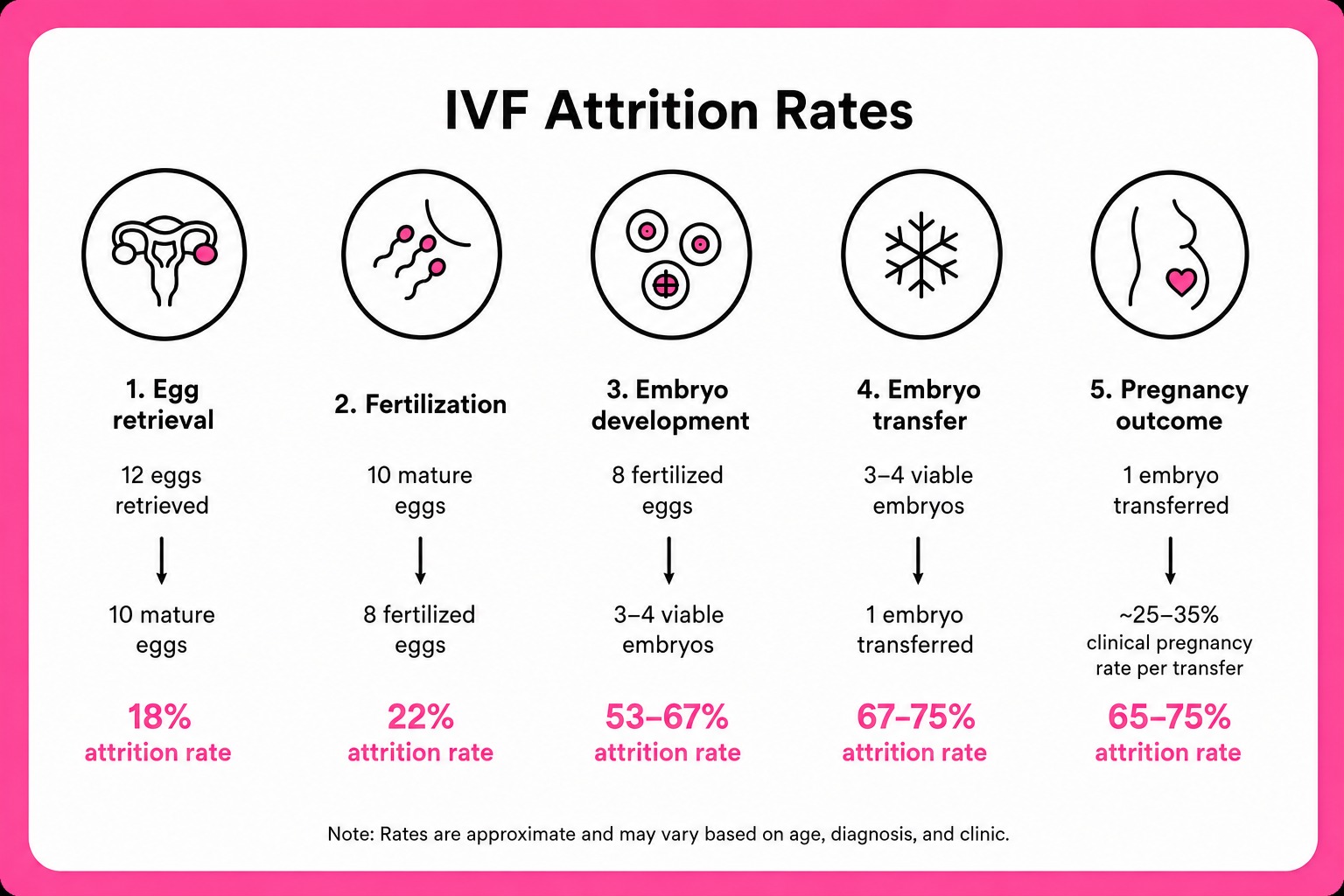
Before we get into success rates: the number of eggs you retrieve is not the number you will actually use, and you may need more than one retrieval.
Every clinic has a success rate on its website. If yours doesn’t, run. What most women are never told is how those numbers change with age. Every clinic is legally required to report outcomes to the CDC, which makes CDC and SART data the most honest comparison you can find. Here is roughly where live birth rates land per cycle, using your own eggs.
| Your age | Approx. live birth rate per cycle (own eggs) |
|---|---|
| Under 35 | 40 – 50% |
| 35 – 37 | 30 – 35% |
| 38 – 40 | 20 – 25% |
| Over 40 | Often single digits |
| Donor eggs (any age) | 45 – 55% per transfer |
Read those numbers gently. A 30% chance in a single cycle is not a small thing, and it is also not the near-guarantee that IVF is often made out to be. This is exactly why the cost math and the odds have to be read together. If you are 39 and looking at a 20 to 25% chance per cycle at roughly $23,500 a cycle, you deserve to know that going in.
One more piece of honesty. The CDC counts success “per intended egg retrieval,” which includes cycles that were cancelled or where no embryo made it to transfer. That is actually the fair way to count, because it reflects real life, not just the cycles that went perfectly.
When it is the right call
When IVF is genuinely your best next step
I want to be very clear here, because it is the part people do not expect a “natural fertility” person to say. There are situations where IVF is the smart, science-backed choice, and when I see them, I say so. If you have both tubes blocked or missing, IVF may be your most direct path. If there is significant male-factor infertility, severe endometriosis, or certain genetic considerations, IVF earns its place. A blocked or missing tube alone can drop your natural odds by 30 to 50%, and I will show you exactly what that looks like for your situation rather than pretending it away.
When a woman I work with has one of these pictures, I do not just wave her toward the clinic. I write up, based on the research, what her odds of success actually look like, what to expect from her egg retrievals, and what the whole process will involve, so she can make a genuinely informed decision instead of a scared one.
The goal was never “avoid IVF.” The goal is to make sure IVF is answering a question your body actually asked.
The question no one asks first
Are you actually infertile?
Here is the clinical definition, and it surprises most people. If you are under 35 and have been trying for a year without conceiving, that is when medicine calls it infertility. Over 35, the clock is six months. That is the cutoff. That is the whole thing.
Notice what that definition does not measure. It does not ask whether you were trying at the right time. It does not ask what your actual fertile window is. It just counts months. And the moment you cross that line, a frightening word gets attached to you.
So before you accept the label, know this: you really only have about three to six days in any given month where conception is even possible. Three to six days. And most women are never taught how to find theirs.
Girl, you’re missing your window completely. She had been off by days, every single month, for two years. We had her pregnant in about three and a half months. Nothing was wrong with her body.
Normal vs Optimal
“Normal” and “optimal” aren’t the same thing
When your labs come back “normal,” that means you are within the normal range for a healthy woman your age. But the range that is normal for a healthy woman is not the same as the range that is best for a woman actively trying to conceive. A body trying to make a baby has a tighter target.
Blood sugar is my favorite example. A woman will tell me, “My A1C is 5.4, my doctor said I’m fine.” And she is fine, for someone who is not trying to conceive. But I want her closer to 5.3, because tighter blood sugar control genuinely helps conception. Same body, different target, because the goal is different.
| Biomarker | Standard “normal” | Range I aim for |
|---|---|---|
| HbA1c (blood sugar) | Under 5.7% | Under 5.2 – 5.4% |
| Fasting insulin | 2 – 25 μIU/mL | 2 – 8 μIU/mL |
| Vitamin D (25-OH) | Over 30 ng/mL | 40 – 60 ng/mL |
| Ferritin (iron stores) | 15 – 150 ng/mL | 50 – 100 ng/mL |
| hs-CRP (inflammation) | Under 3 mg/L | Under 1 mg/L |
That inflammation marker at the bottom matters more than most women realize, especially if you have fibroids or cysts, because those are driven by inflammation. When your body is running hot with inflammation, it feeds those fibroids and cysts, and it makes the uterine environment a harder place for an egg to implant. So sometimes the work before conception is simply calming that inflammation down.
None of these numbers are about being “healthier” in the abstract. They are specific, hittable targets that make your body a better place to grow a baby. That is the difference between a checkup and a plan.
Practical
How to actually find your fertile window
Good
Calendar tracking
If your cycles are regular, ovulation usually happens about 12–14 days before your next period, not automatically on “day 14.” A 32-day cycle likely ovulates around day 18. This alone corrects a lot of mistimed months.
Better
Add your body’s own signals
Cervical mucus becomes clear, stretchy and slippery near ovulation, your body announcing peak fertility. Basal body temperature, taken the moment you wake, rises slightly after ovulation and confirms it happened. Together with cycle tracking, this is the symptothermal method.
Best
Add hormone data
This is what I did for myself. I tracked my cycle every day with a lab-grade device (the Inito) that reads your actual hormone values instead of a color change. I could see my LH surge and know I had about 36 hours of prime viability.
I told my husband, “If we have sex this week, I will get pregnant, just so you know.” Two weeks later I was holding a positive test with my one-year-old trying to climb into my lap. That is the level of precision I want you to have. Not luck. Knowing.
The middle path
The middle road most women are never shown
The market gives you two poles. On one side, the clinical pole: do IVF, here is the financing. On the other, the wellness pole: track your cycle, lower your stress, drink the tea. One feels too invasive and expensive. The other feels too soft to trust. And you are stuck in between.
There is a middle, and it is where I live. It is the marriage of what is natural and what is scientific. It is calming inflammation and hitting real biomarker targets and pinpointing your window with actual hormone data, and also being honest enough to say “you do need IVF, and here is why” when the data says so.
It’s different because it isn’t just labs. I would have to see two different providers, medical and holistic, to get what Cyntia provides. Her own journey and truly understanding the walk makes a huge difference. It doesn’t feel like someone trying to convince you of something they don’t even believe in.
A quick, honest self-check
Before you spend a dollar on IVF
No one is grading you. Tap each one that’s true today.
0 of 7 complete
Nothing checked yet? That is good news, not bad. An incomplete picture is a fixable one — you may be closer to conceiving than any scary label has told you.
Take a breath
What you actually know now
You now know that IVF in 2026 is real, improving, and worth zero shame, and also that it costs closer to $50,000 across the cycles most people need, not the single-cycle sticker price. You know where the add-ons hide. You know the honest odds by age. You know when IVF genuinely is the right call, and you know that for a lot of women there is a prior question no one asked: are you actually infertile, or are you just missing a three-to-six-day window every month?
You know that “normal” labs and “optimal for conception” labs are different targets. You know inflammation, blood sugar, and your partner all matter. And you know there is a middle path between the clinic and the wellness aisle, one built on real data.
You are very likely not broken. In my experience, the puzzle is usually just not put together yet. The pieces are there.
Do this next
Your next steps
- 1
Stop counting months and start finding your fertile window. Use the calendar rule, then add cervical mucus and basal body temperature this cycle.
- 2
Ask your doctor for your actual lab values, not just “you’re normal.” Compare A1C, fasting insulin, vitamin D, ferritin and hs-CRP against the conception-optimal targets above.
- 3
Get your partner assessed now, not six months from now.
- 4
If you are weighing IVF, write down the real all-in number across the two to three cycles your age suggests, with the add-ons, before you decide.
- 5
Get a second opinion on the label itself before you accept “infertile.”
If you want a real answer about your body
The Kopela Case Review
A focused, one-on-one look at your specific situation. I read your numbers and history the way I read my own, tell you honestly whether IVF looks necessary for you, and give you a clear picture of what your body actually needs to conceive, for a small fraction of a single IVF cycle.
If you are tired of “just relax” and ready for someone to look at you specifically and tell you the truth, that is the next step.

P.S. Even if we never work together, keep this report. Read it before your next clinic appointment. The woman who walks in knowing her window, her numbers, and her real costs gets a very different conversation than the woman who walks in scared. Be the first one.
This guide is educational and is not a substitute for individual medical advice. Success rates and costs cited reflect 2026 CDC/SART, ASRM, and published industry data and vary by individual and clinic.
Dr. Cyntia Onuoha-Brown, PharmD · Kopela Health